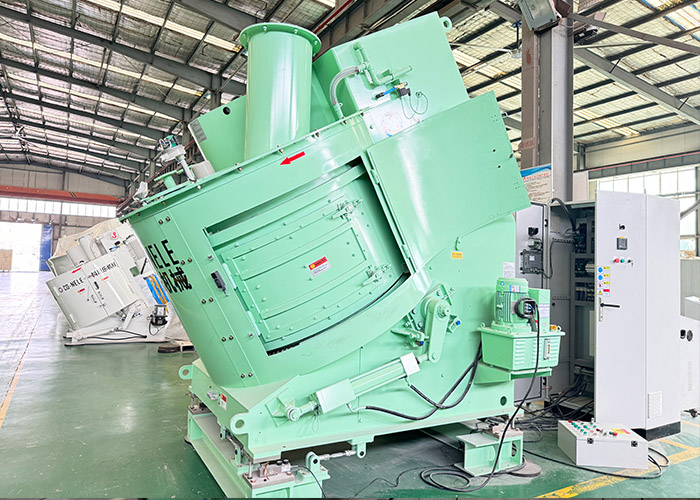
With the rapid advancement of solid-state batteries and next-generation lithium-ion batteries, dry electrode processing has emerged as a pivotal technological direction for simultaneously boosting energy density and reducing manufacturing costs. Compared to traditional wet-coating techniques, the dry electrode process eliminates the use of solvents and the subsequent drying step, thereby significantly simplifying the battery manufacturing workflow.As a specialized manufacturer of battery material mixing equipment, CO-NELE intensive mixer has developed comprehensive dry electrode mixing solutions specifically designed to address the fibrillation of PTFE, the dispersion of conductive materials, and the homogenization of dry powders.What is the Dry Electrode Process?The dry electrode process leverages the unique fibrillation properties that PTFE exhibits when subjected to intense mechanical shear forces. During the high-speed mixing process, PTFE particles are stretched into nanoscale fibers; these fibers intertwine to weave the active materials and conductive agents into a robust, three-dimensional network structure.Unlike traditional slurry-coating techniques, the dry electrode process requires no solvents—such as NMP—thereby drastically reducing:- The need for solvent recovery systems
- Energy consumption during the drying phase
- Environmental emissions
- Production costs
Concurrently, dry electrode technology enhances:- Electrode compaction density
- Electronic conductivity
- Battery energy density
- Process sustainability
Key Production Steps of the Dry Electrode Process
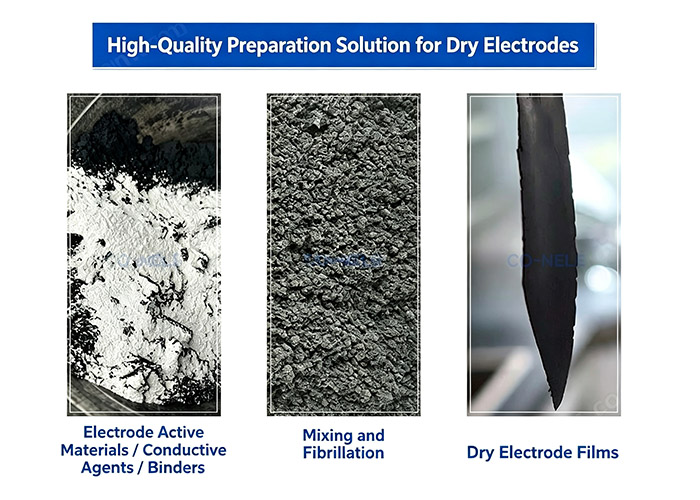
1.Dry Powder MixingActive materials, conductive additives, and PTFE binders are fed into a specialized dry electrode intensive mixer for uniform pre-mixing.Typical materials include:- Lithium Iron Phosphate (LFP)
- NCM Ternary Materials
- Graphite
- Carbon Black
- CNT (Carbon Nanotube) conductive agents
The uniformity of this dry powder mixture directly dictates the consistency and electrochemical performance of the resulting electrode.2. PTFE FibrillationThis constitutes the core step of the dry electrode process.Inside the PTFE fibrillation mixer, high-speed mechanical shear forces transform the PTFE particles into a fibrous network structure. These nanofibers anchor to and encapsulate the active material particles, thereby creating a stable, self-supporting electrode structure. Precise control is exercised over the following parameters:- Mixing Intensity
- Rotor Speed
- Mixing Temperature
- Shearing Duration
This is of critical importance, designed to prevent instances of excessive fibrillation or fiber breakage.3. Roll PressingThe fibrillated powder mixture enters the roll pressing system, where, through a continuous compression process, it is ultimately formed into a self-supporting electrode film, typically ranging in thickness from 120 to 200 microns.4. Hot Press LaminationThe electrode film is laminated onto an aluminum or copper foil substrate using a hot-pressing process, thereby producing the final electrode sheet.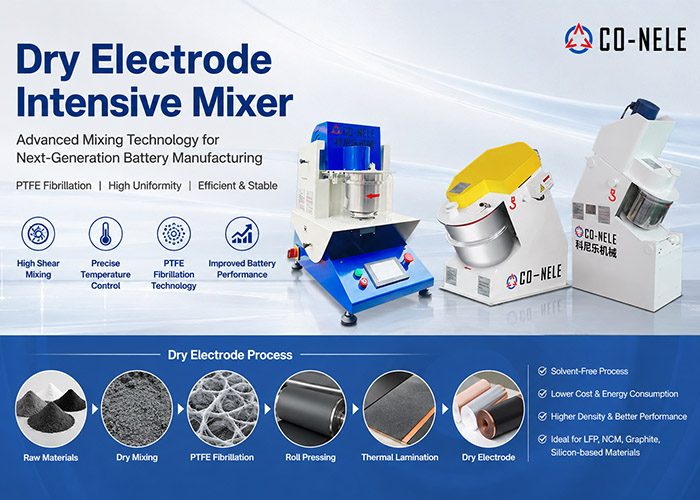
Advantages of the CO-NELE Dry Electrode Intensive Mixer
As a core piece of equipment in the dry electrode manufacturing process, the CO-NELE intensive mixer for battery materials delivers highly efficient mixing performance and stable PTFE fibrillation capabilities.- High-Uniformity MixingThe CO-NELE lithium battery mixer employs intensive counter-current mixing technology to ensure an exceptionally high degree of uniformity in powder dispersion.Mixing RSD (Relative Standard Deviation) ≤ 5%Excellent batch-to-batch consistencyIdeal for the dispersion and mixing of conductive agentsEnsures stable electrode performanceThe fibrillation process of PTFE is extremely sensitive to temperature. The CO-NELE dry electrode mixer features the following temperature control capabilities:Temperature Range: -10°C to 250°CTemperature Accuracy: ±3°CThis feature helps optimize the formation of PTFE fibers while simultaneously preventing thermal damage to sensitive battery materials. - High-Speed Shear MixingThe CO-NELE intensive mixer for dry electrode processing offers rapid mixing speeds, enabling:Rapid fiberizationEfficient dispersion of conductive additivesShortened batch production cycles- Flexible Process AdaptabilityCO-NELE battery material mixers support the following process modes:HeatingCoolingVacuum operationContinuous productionBatch productionA wide range of models is available:Laboratory-scale mixers: 1L / 2L / 5LPilot-scale systemsIndustrial-scale mixers (with capacities up to 7000L)This ensures a seamless transition during the process scale-up from the R&D phase to mass production.Why is Dry Electrode Technology Crucial?Dry electrode manufacturing processes are becoming increasingly vital for the following sectors:- Solid-state batteries
- High-energy-density lithium batteries
- Fast-charging battery systems
- Sustainable battery manufacturing
As battery manufacturers strive to reduce carbon emissions and enhance production efficiency, dry electrode mixing technology will continue to play a pivotal role in the manufacturing of next-generation batteries.
Tags:
Dry Electrode Intensive Mixer
PTFE fibrillation mixer
CO-NELE battery material mixer
Back To The List