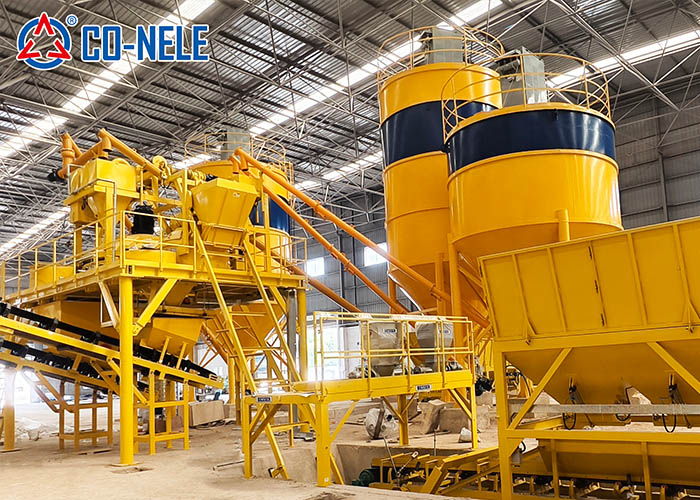
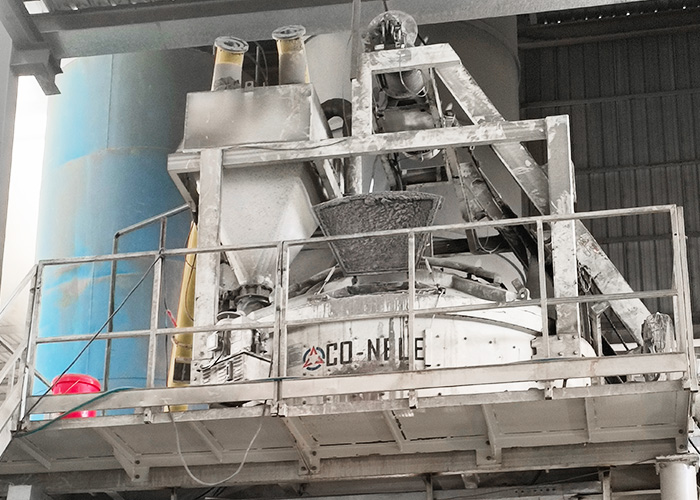
A suitable flux granulator must do more than turn fine powder into granules. It needs to achieve consistent particle size, uniform material distribution, and stable production capacity. In a customer material test, the CO-NELE intensive mixer successfully processed flux materials into 0.5–1.6 mm granules. The test confirmed its ability to support efficient granulation, flexible particle size adjustment, and uniform finished granules.The customer ultimately purchased the CR15 intensive mixer with a capacity of 2 tons per hour.
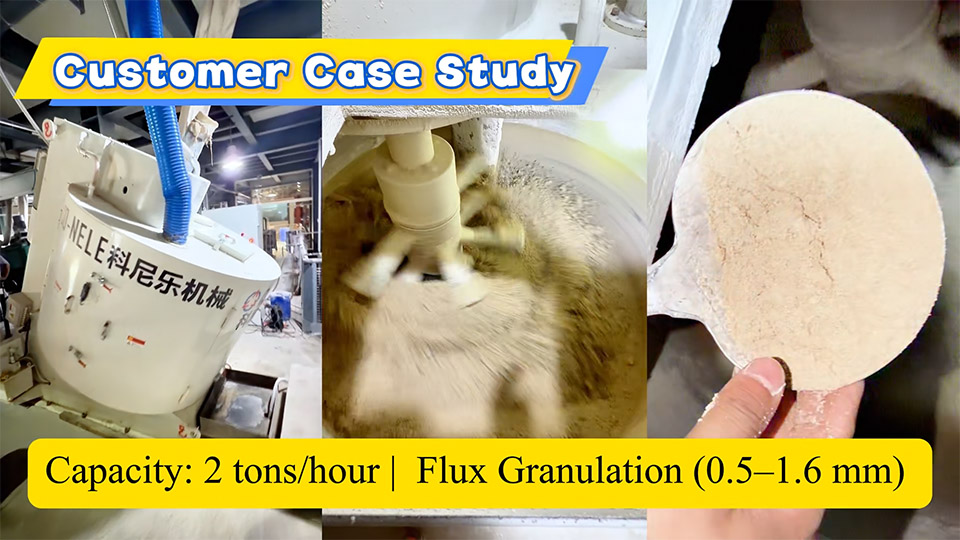
CR15 Flux Granulator: 0.5–1.6 mm Particles at 2 Tons per Hour
Ⅰ. Customer TestDuring the initial material testing stage, the customer evaluated the granulation performance of the CO-NELE intensive mixer using actual flux raw materials.The objective was to determine whether the equipment could produce granules within the required particle size range while maintaining efficient processing.Test results at a glance:| Parameter | Test Result |
| Material | Flux |
| Equipment | CO-NELE Intensive Mixer |
| Target particle size | 0.5–1.6 mm |
| Granulation performance | Uniform granules |
| Process | Mixing and granulation |
The test demonstrated three important results:
- High granulation efficiency: Rapid processing from fine powder to granules.- Adjustable particle size: Flexible process adjustment to meet different granulation requirements.- Uniform granule formation: Consistent particle appearance and stable granulation performance.For manufacturers evaluating a new flux granulation process, actual material testing provides a practical basis for equipment selection and production planning.
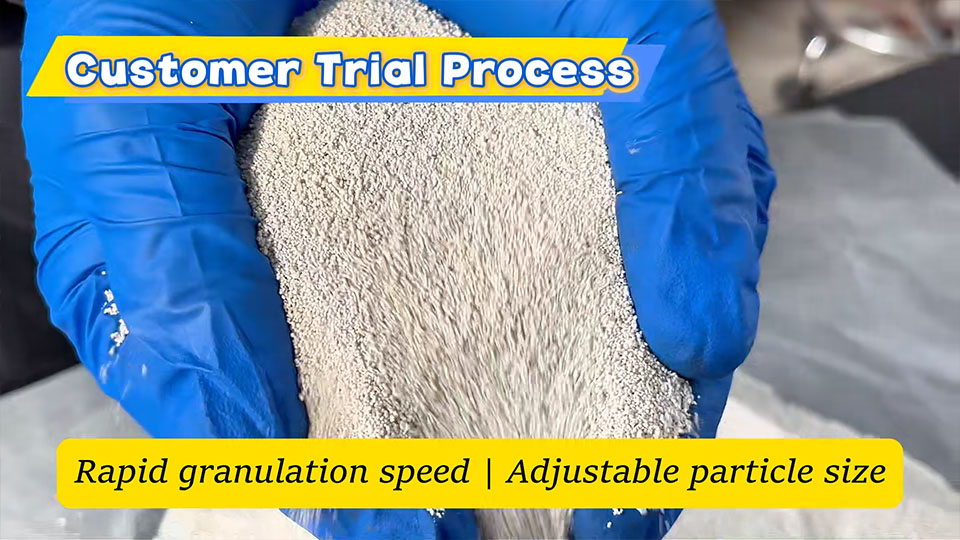
Customer Test: Flux Granulation
Ⅱ. How Does an Intensive Mixer Granulate Flux Powder?Flux materials may contain multiple powder components with different particle sizes, densities, and physical properties. Achieving uniform granulation requires effective mixing before and during particle formation.A CO-NELE intensive mixer integrates three key functions:
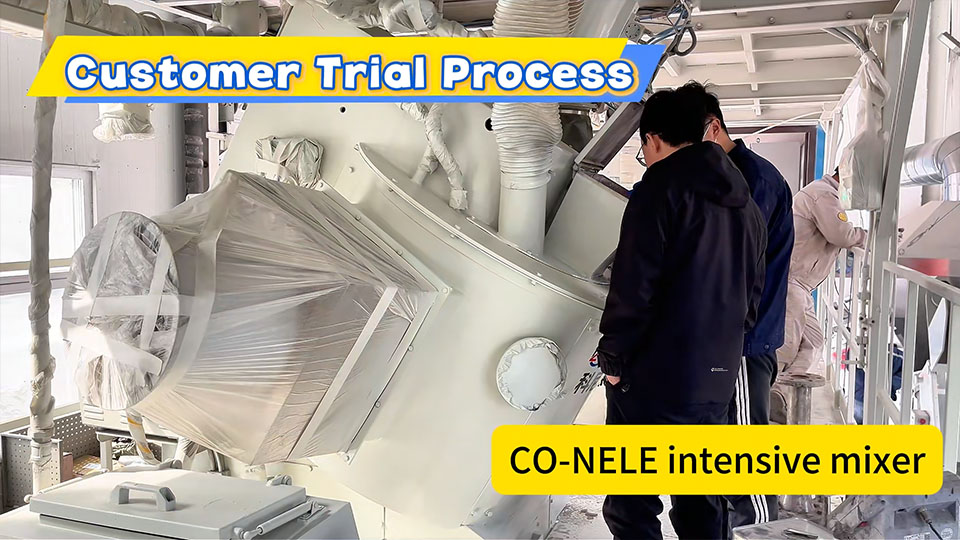
CO-NELE intensive mixer
1. Intensive MixingThe inclined mixing chamber and mixing tools create intensive material movement, helping distribute different powder components evenly.2. Liquid Addition and DispersionWater or a suitable liquid binder can be introduced according to the material formulation. Effective liquid distribution helps particles establish contact and form granules.3. Granule FormationUnder the combined action of mixing and mechanical movement, fine particles gradually aggregate into larger granules. Operating conditions can be adjusted according to the desired particle size and material characteristics.The key advantage is that mixing, dispersion, and granulation can be integrated into one processing system, reducing the need for separate equipment for these stages.Ⅲ. Why Choose a CO-NELE Flux Granulator?CO-NELE intensive mixers are designed for applications requiring intensive mixing, material dispersion, and granulation.Key advantages include:- Integrated Processing: Combines mixing, dispersion, and granulation in one machine.- Uniform Material Distribution: Helps improve the consistency of multi-component powder mixtures.- Flexible Process Adjustment: Operating conditions can be optimized for different materials and particle size requirements.- Industrial Production Capability: Equipment selection can be matched to required processing capacity.- Material-Specific Testing: Actual raw materials can be tested before final equipment selection.For flux manufacturers, the appropriate machine configuration should be determined by material characteristics, required particle size, binder conditions, and target output.
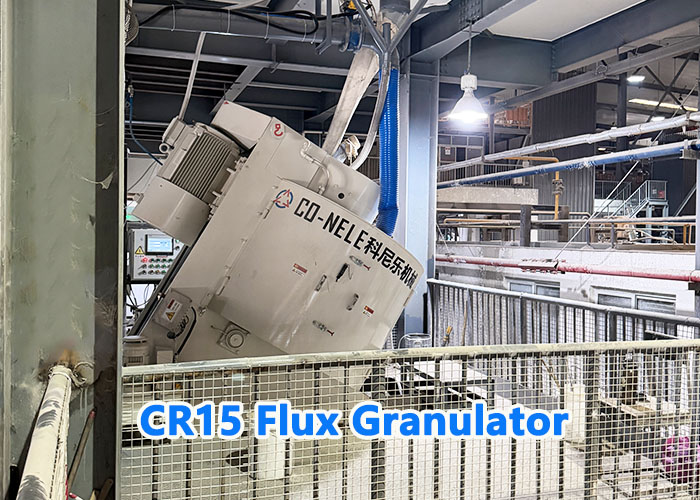
CR15 flux granulator
Ⅳ. Flux Granulator ApplicationsDepending on material formulation and process requirements, intensive mixing and granulation equipment can be evaluated for various industrial powder applications, including:- Metallurgical covering flux- Casting flux and casting powder- Ladle covering agents- Mineral-based powder mixtures- Other fine powder materials requiring controlled granulationDifferent flux formulations may behave differently during granulation. Material testing is therefore essential before confirming the final equipment configuration.Ⅴ. Frequently Asked Questions About Flux GranulatorsQ1: What is a flux granulator?A flux granulator is industrial equipment used to convert fine flux powder into larger, more uniform granules. Depending on the material and process, granulation can involve mixing, liquid addition, particle adhesion, and granule growth.Q2: Can the particle size be adjusted?Yes. Particle size can be influenced by adjusting the liquid addition, mixing intensity, processing time, and other process parameters. Material testing is recommended to establish the appropriate operating conditions.Q3: Why is intensive mixing important in flux granulation?Intensive mixing helps distribute different powder components and liquid binders more evenly. This is particularly important when processing multi-component materials with differences in particle size and bulk density.Q4: Should flux materials be tested before purchasing a granulator?Yes. Testing actual raw materials helps determine granulation behavior, suitable process parameters, achievable particle size, and practical production capacity before industrial equipment is selected.Ⅵ. Test Your Flux Materials with CO-NELEChoosing a flux granulator based only on equipment specifications may not guarantee the required granulation results.CO-NELE provides material testing and equipment selection support to help manufacturers evaluate granulation performance before moving to industrial production.Contact CO-NELE to arrange a material test and explore an industrial flux granulation solution.