26
+
YEAR
CO-NELE Has Obtained More Than 80 National Technology Patents & More Than10,000
Mixers.
Close search
Municipal solid waste incineration fly ash (MSWI fly ash) contains heavy metals, soluble salts and potentially toxic dioxins, requiring appropriate treatment before disposal or resource recovery. Whether the treatment process involves chemical stabilization, water washing, cement kiln co-processing or ceramic aggregate production, effective material preparation is essential. A suitable fly ash mixer granulator combines intensive mixing and granulation in one machine, helping achieve uniform additive distribution and consistent granule formation for downstream processing.
As landfill capacity becomes increasingly constrained, more attention is being given to fly ash treatment and resource recovery technologies.
Common treatment methods include:
| Treatment Method | Main Objective | Mixing & Granulation Requirements |
|---|---|---|
| Solidification and stabilization | Reduce heavy metal leaching risks | Uniform mixing of fly ash, chelating agents and cementitious binders |
| Water washing | Remove soluble salts, especially chlorides | Homogeneous material preparation and possible post-treatment granulation |
| Cement kiln co-processing | Utilize suitable treated materials in cement production | Consistent material conditioning and controlled feeding |
| Sintering and ceramic aggregate production | Convert prepared materials into granular products | Uniform mixing, moisture conditioning and controlled granulation |
| High-temperature melting | Produce stable molten or vitrified materials | Consistent feed preparation and process-specific conditioning |
Each technology has different requirements, but material homogeneity and stable feeding are important throughout the process.
Mixing and granulation perform two different functions: mixing ensures uniform material composition, while granulation converts prepared powder or wet mixtures into particles suitable for subsequent processing.
In chemical stabilization, fly ash is mixed with chelating agents, cementitious binders and water.
If additives are distributed unevenly, different portions of the material may receive different treatment conditions, potentially affecting stabilization consistency.
A suitable fly ash mixing system should provide:
Effective dispersion of fine fly ash particles.
Uniform distribution of chemical additives and binders.
Consistent liquid addition and material wetting.
Repeatable mixing results between batches.
Mixing uniformity is therefore an important process variable when developing a reliable fly ash stabilization formula.
Fine fly ash powder can create handling difficulties during conveying, storage, metering and feeding.
For processes requiring granular feedstock, granulation helps transform fine powders or conditioned mixtures into particles with more suitable physical characteristics.
Key objectives include:
Controlling particle size distribution.
Improving material flow and handling.
Reducing dust generation during subsequent handling, subject to appropriate equipment configuration.
Providing more consistent feeding for downstream equipment.
Fly ash granulation is not simply about converting powder into pellets. The real challenge is balancing material homogeneity, liquid distribution, granule growth and downstream process requirements.
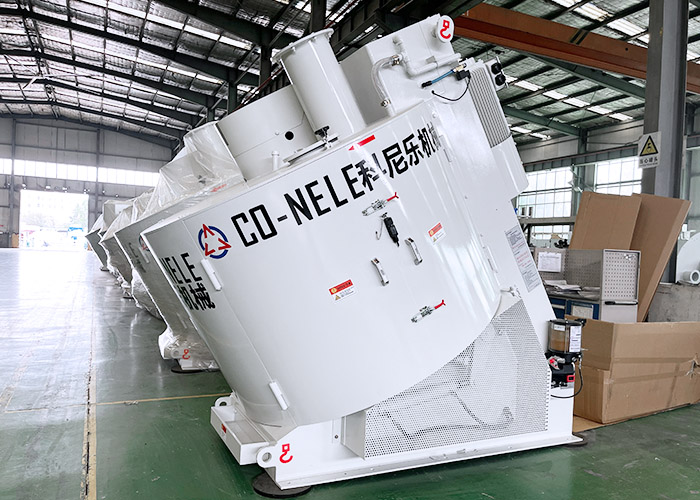
CO-NELE intensive mixer granulators integrate intensive mixing and granulation through the coordinated operation of three main components.
1. Rotating Mixing Pan
The inclined rotating pan continuously moves the material, promoting circulation throughout the mixing chamber.
2. High-Speed Eccentric Rotor
The rotor generates intensive mechanical movement, breaking down agglomerates and promoting contact between fly ash particles, binders and liquids.
3. Fixed Scrapers
Wall and bottom scrapers remove accumulated material from the mixing surfaces, helping reduce material buildup and dead zones.
Together, these components create a three-dimensional turbulent mixing field.
The processing sequence generally involves three stages:
Dry Mixing: Fly ash and other dry ingredients are introduced and intensively mixed to improve material uniformity.
Liquid Addition and Granulation: Water or a suitable binder is added according to the formulation. Mechanical shearing, particle collisions and rolling promote granule formation and growth.
Granule Adjustment and Discharge: Rotor speed, pan speed and processing time are adjusted to achieve the required granule characteristics before discharge.
This integrated configuration allows mixing and granulation to take place in one machine, reducing intermediate material transfer.
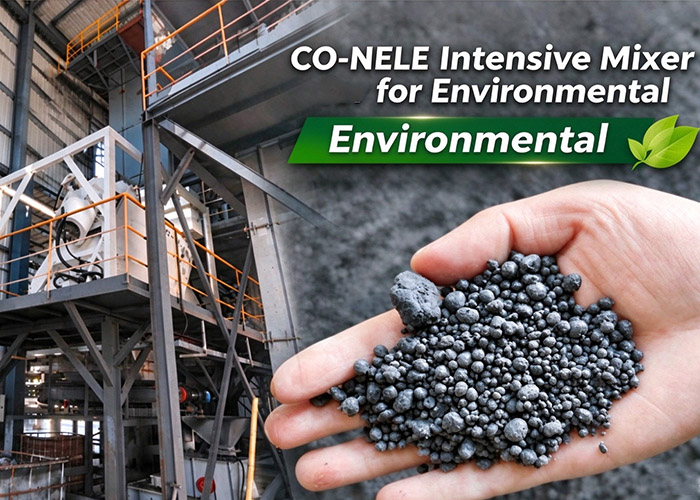
Fly Ash Mixer Granulator for Fly Ash Treatment | CO-NELE
Combining two processing stages in one machine simplifies the production layout and reduces intermediate material handling.
Wet fly ash and binder-containing mixtures can adhere to equipment surfaces and form agglomerates.
The intensive rotor, rotating pan and scraper system promote continuous material movement and help reduce material accumulation.
Granule size is influenced by rotor speed, mixing pan speed, liquid addition, binder dosage, raw material properties and processing time.
These parameters can be adjusted according to the target particle size distribution and downstream process requirements.
A PLC control system with variable-frequency drives can be configured to store operating recipes, including relevant mixing speeds and processing parameters.
This helps improve process repeatability when changing formulations or production batches.
For hazardous waste applications, the equipment can be configured with an enclosed structure and dust collection connections to support dust containment and cleaner material handling.
The sealing, extraction and discharge systems should be designed according to the project's environmental and occupational safety requirements.
Fly ash properties vary depending on the incineration process, flue gas treatment system, moisture content, soluble salts and chemical composition.
Consequently, a formulation that works for one fly ash source may not produce the same results with another.
Before selecting industrial equipment, laboratory testing is recommended to establish a suitable formulation and operating window.
| Testing Parameter | Evaluation Objective |
|---|---|
| Raw material characteristics | Moisture, particle size and material composition |
| Binder formulation | Binder type, dosage and liquid-to-solid ratio |
| Mixing performance | Homogeneity and additive distribution |
| Granulation performance | Granulation rate, particle size and shape |
| Product properties | Bulk density, moisture and strength, where relevant |
| Process repeatability | Consistency between multiple test batches |
CO-NELE provides mixer granulator solutions ranging from 1 L laboratory models to 7,000 L industrial models.
This allows customers to evaluate raw materials and granulation formulations at laboratory scale before proceeding with pilot or industrial production.
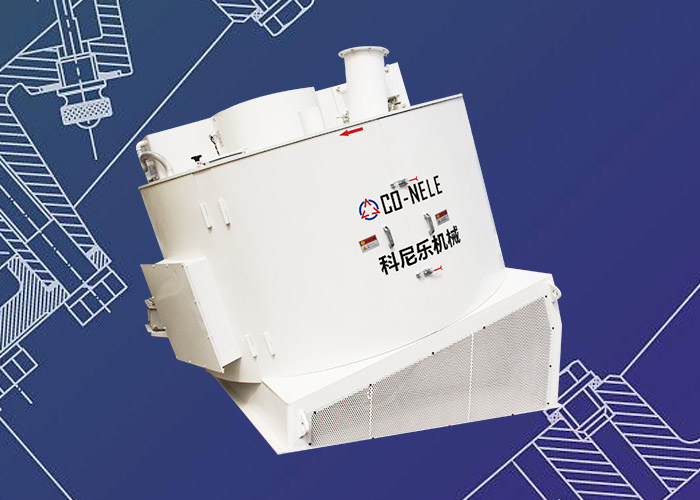
Fly Ash Mixer Granulator
With more than 20 years of experience in industrial mixing and granulation, CO-NELE provides equipment for fly ash, industrial dust, sludge and other solid waste processing applications.
Its mixer granulator range supports laboratory testing, process development and industrial production.
Typical application areas include:
Municipal solid waste incineration fly ash.
Fly ash and cementitious binder mixing.
Fly ash granulation for resource recovery.
Industrial dust and sludge granulation.
Powder preparation for ceramic and building material production.
From laboratory trials to industrial equipment selection, CO-NELE helps customers develop mixing and granulation processes based on their material characteristics and production requirements.
Looking for a fly ash mixer granulator for your treatment or resource recovery project?
Contact CO-NELE with your raw material information, target granule size, processing capacity and downstream application. Our technical team can help evaluate your requirements and recommend a suitable mixing and granulation solution.
An intensive mixer granulator combines material mixing and granulation in one machine. It is suitable for fine powders, wet mixtures and materials requiring controlled particle formation.
Yes. Subject to material characteristics and equipment configuration, the intensive rotor, rotating pan and scraper system can help process sticky mixtures and reduce material accumulation.
Granule size is influenced by rotor speed, pan speed, binder dosage, liquid addition, raw material characteristics and processing time. Laboratory testing helps establish suitable operating parameters.
Uniform distribution of chelating agents, cementitious binders and water helps provide consistent treatment conditions throughout the material. Poor mixing can lead to localized differences in additive concentration and potentially inconsistent stabilization performance.
Yes. Laboratory mixer granulators can evaluate formulations, moisture levels, binder ratios, granulation behavior and particle size distribution before full-scale equipment selection.
CO-NELE offers laboratory and industrial mixer granulator models with capacities ranging from approximately 1 L to 7,000 L. The appropriate model depends on material characteristics, batch size and production requirements.

Phone: 0086-15253277366
Hougu Town Village, Xiazhuang Street, Chengyang District, Qingdao
Copyright © CO-NELE 2019.
We will contact you within 24 hours.